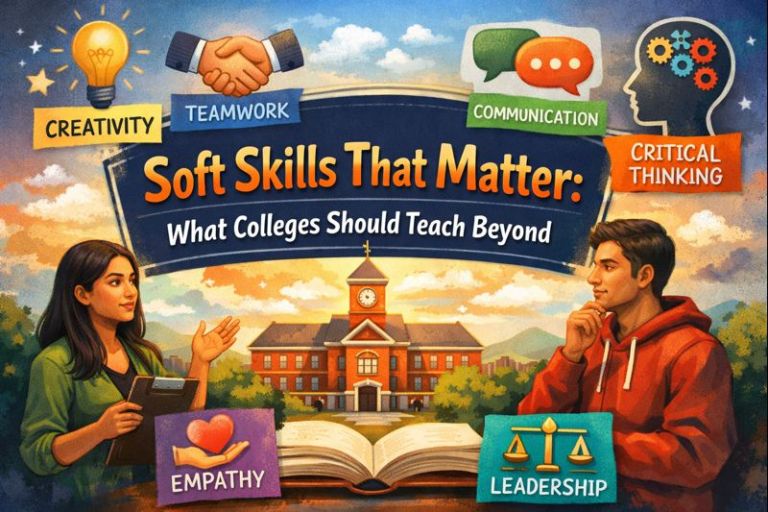
In the current scenario, where the world is moving so swiftly, merely academic knowledge is not sufficient to ensure a successful and prosperous life. Organizations in Bhopal, Indore, Gwalior and Jabalpur and even in the whole of Madhya Pradesh, have reportedly remarked that new graduates possess essential skills that are not found in their academic curriculum but are required in their organizations.
People’s University in Bhopal is aware of the growing need and puts a thrust on a holistic education system, filling the gap that lies between learning and applications in a real-world scenario. This blog will briefly highlight the essential skills required to be inculcated in the college going population and their importance in the context of a career in Madhya Pradesh or any other state, for that matter.
1. Communication Skills – The Foundation of Professional Success
Clear communication is one of the most essential soft skills for employability.
- Many graduates find it difficult to communicate their ideas clearly in interview settings, presentations and professional interactions.
- Colleges should add activities like group discussion, public speaking courses, languagelabs as well as writing centers.
- There should be greater emphasis on spoken English proficiency and Hindi language competence that is regional in the context of Madhya Pradesh-based employers.
2. Critical Thinking and Practical Decision-Making
- While academic achievement involves rote learning of facts, real life situations demand analytical thinking.
- Critical thinking enables students to assess problems, find their solutions and make decisions.
- Introducing real-life case studies, especially those linked to Indian business scenarios and local industriesbuilds practical judgment.
- These exercises help students transition from classroom learners to workplace contributors.
3. Managing Emotions
Emotions have been found to have a great effect on people’s lives. Being able to understand and control emotions is very important in both
- Emotional Intelligence increases team working, conflict resolving, stress management and relationship building.
- Colleges should provide opportunities for mentorship, counseling, emotional awareness workshops and peer support systems.
- Emotional intelligence helps employees better deal with the pressure environment of a business establishment. The employees possessing better emotional intelligence can better handle job
4. Collaboration and Teamwork
In modern times, work is less often undertaken alone.
- An employer desires applicants who can work well in heterogeneous groups.
- Group activities, team assignments, cultural programs and sporting activities foster teamwork.
- These activities will inculcate the concept of roles, responsibilities, importance of joint efforts, which are integral parts of success in the profession.
5. Time Management and Organization
Managing time effectively is essential for meeting deadlines and achieving career pretensions.
- scholars frequently struggle with balancing academic tasks, internships and particular commitments.
- Structured schedules, realistic thing setting and time- operation training can help scholars come more productive.
- Time operation chops are especially precious for scholars preparing for competitive examinations or planning multi-tasking careers.
6. Rigidity and nonstop literacy
The professional world is evolving fast, especially with digital metamorphosis and arising diligence.
- scholars must learn new tools, technological changes and interdisciplinary job places.
- Colleges should encourage short- term instruments, hands- on shops, internships and exposure to assiduity trends.
- This mindset of nonstop literacy enhances confidence and future- attestations careers.
7. Leadership and Initiative
Leadership doesn’t only belong to directors; every pupil can lead in their own way.
- Leadership training helps scholars take power, make opinions and inspire others.
- Pupil councils, community systems, event operation places and entrepreneurship cells help nurture leadership capability.
- These rates are critical for scholars who aspire to start businesses, work in NGOs or pursue public administration careers.
8. Professional Ethics and Workplace Etiquette
Academic learning doesn’t always prepare students for workplace norms.
- Professional behavior includes respect, punctuality, responsibility and ethical conduct.
- Colleges should offer training on workplace etiquette, digital professionalism and accountability.
- These expectations are often the difference between being hired and being successful long-term in a job.
How People’s University is Helping Shape the Future
The university’s programs are designed to integrate soft skill development with academic excellence. Through workshops, industry interactions, career counseling and experiential learning, People’s University prepares students to enter the job market with confidence and competence.
Whether you are a student in Madhya Pradesh or embarking on your higher education journey, it may prove to be an absolute game-changer to pay attention to soft skills education, side by side with academics. The type of education imparted at colleges that focus on communication skills, emotional quotient, leadership or adaptability helps students to not only get a ‘job’ but to create a career.