
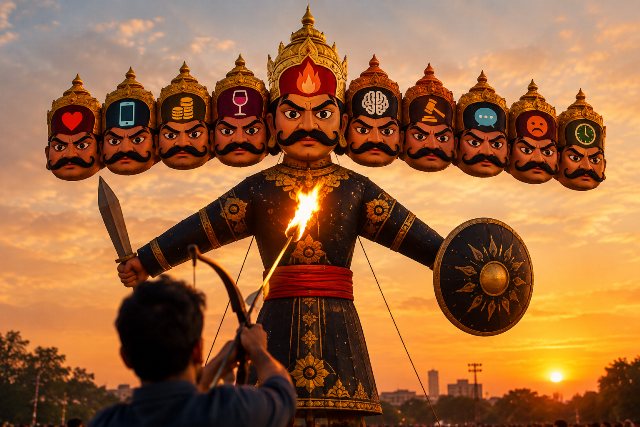
A student’s guide to what really needs to go up in flames on 20 October
Every year the same thing happens. The effigy goes up, somebody lights it, the crackers go off, and everyone cheers like they personally defeated evil. Ravan had ten heads, and each one is supposed to stand for something bad. Pride, anger, greed, you know the list. But have you seen your own list? Mine has a few extra heads Ravan never had, mostly to do with deadlines. So this Dussehra, here’s how I’d do it if I were a student: ten heads, ten habits, ten tiny plans.
First, the story
Dussehra, or Vijayadashami, is the day Lord Rama beat Ravan. In some places it’s also the day Goddess Durga finished off Mahishasura, which is why the nine nights of Navratri lead up to it. Different story, same idea. Something that looked impossible to beat gets beaten.
The ten heads
1. “Kal se pakka.” You’ve said it every night this month. Start for ten minutes today. Ten minutes becomes an hour more often than you’d think.
2. The phone. You pick it up to check one message and look up forty minutes later, with no idea what happened. Try studying with it in another room. It’s weirdly quiet in there.
3. Comparing. Someone got the better internship, the better score, a better phone, and their life looks great on Instagram. It’s their highlights reel. Compete with your own last semester instead, it’s an easier opponent and a fairer one.
4. Ego. You didn’t ask the doubt because everyone would think you’re slow. Ravan was a brilliant scholar, and his pride finished him anyway. Ask. Half the class has the same doubt and is hoping someone else goes first.
5. 11 pm studying. Everyone swears it’s the last time. It never is. Even thirty minutes a day beats a whole night of panic.
6. Skipping. One lecture becomes five. Show up when you’re sleepy. Honestly, half of learning is just being in the room.
7. Gossip. Fun in the canteen, a bit sour by evening. A good rule: if you wouldn’t say it to their face, maybe don’t say it.
8. Temper. A snappy reply in the group chat over something small. One breath before you type can save a friendship. Try it once.
9. Fear of speaking. You know the answer, you stay quiet, and the person next to you says it worse and gets the marks. Say one line out loud this week. Anything. It gets easier every time.
10. “I’m not good enough.” The biggest head, and it hides well. Everyone has it, even the confident-looking one. Talk to somebody you trust. If it feels too heavy, speak to a counsellor or a mentor. That’s not weakness, it’s just sensible.
What to do with this
Grab a paper. Write the two or three heads that are really yours, and next to each, one small thing you’ll do this week. Just one. Stick it where you’ll see it. Don’t burn it in your hostel room, please, the warden will have questions. Tear it up or bin it, then go and watch the real Ravan dahan with your friends. Show your list to someone too, and check on each other on Sunday.
Why bother
Nobody fixes everything in a night. The story still gets told every year because the point holds up: a big problem is usually a heap of small ones, and you can take them one at a time.
After the festival, the semester picks up fast. Assignments, practicals, exam dates all arrive quicker than you expect. A couple of changed habits now will make that stretch a lot lighter.
So enjoy the sweets, the fair and the fire. When the effigy burns, pick one head and let it go. From all of us at People’s University, a very happy Dussehra to you and your family.