
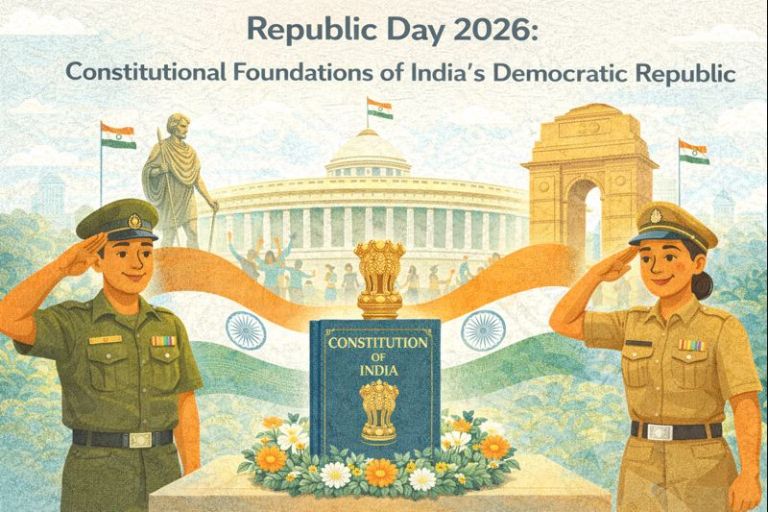
Republic Day 2026: Constitutional Foundations of India’s Democratic Republic
Republic Day is famed every time on 26 January, commemorating the coming into force of the Constitution of India in 1950 and marking India’s formal transition into a Sovereign Democratic Republic governed by the rule of law. Far beyond a conventional festivity, Republic Day represents an indigenous corner that invites reflection on India’s popular governance, institutional design and indigenous values.
The Indian Constitution occupies a unique place in relative indigenous law. It’s the longest written constitution in the world, presently comprising 448 papers (including sub-articles), 25 parts, 12 Schedules and 106 amendments. This detailed constitutional frame reflects a conscious effort by the framers to address India’s vast social, artistic and profitable diversity while icing stability, responsibility and justice.
1. Constitutional Architecture: 448 Articles
The 448 articles (in original Constitution there were 395 articles) of the Constitution give a comprehensive frame governing the structure of the State, distribution of powers, rights and duties of citizens and judicial oversight. Together, they establish aconstitutional balance between popular governance, federalism and the rule of law.
2. Twelve Schedules: Functional and Federal Clarity
The 12 Schedules (in original Constitution there were 8 Schedules) condense the papers by detailing subjects similar as the division of legislative powers between the Union and States, sanctioned languages, land reforms andanti-defection provisions. These Schedules ensure executive clarity and strengthen India’s collaborative civil structure.
3. Constitutional Amendments: Evolution with Continuity
Since 1950, the Constitution has been amended 106 times, demonstrating its rigidity to changing social, profitable and political requirements. Significant amendments include
• 42nd Amendment (1976) preface of Fundamental Duties under Composition 51A
• 73rd and 74th Amendment (1992) indigenous recognition of Panchayati Raj Institutions and Urban Local Bodies
• 101st Amendment (2016) preface of the Goods and Services Tax (GST), reshaping financial federalism
These Amendments reflect constitutional elaboration without compromising foundational principles.
4. Fundamental Rights: The Core of Constitutional Democracy
Part III of the Constitution guarantees Fundamental Rights, which have been expansively interpreted by constitutional courts. papers 14, 19 and 21 frequently described as the constitutional“golden triangle,” cover equivalency, freedoms and the right to life and particular liberty, forming the backbone of India’s rights- grounded justice.
5. Fundamental Duties: Constitutional Morality and Citizenship
fitted by the 42nd Amendment, the fundamental Duties emphasize that republic requires responsible citizenship. Duties similar as respect for the Constitution, creation of harmony and environmental protection support the conception of constitutional morality.
6. Drafting of the Constitution: Deliberative Constitutionalism
Under the chairmanship of Dr. B.R. Ambedkar, the Constituent Assembly engaged in nearly three times of rigorous debate and deliberation. This process assured that the Constitution embodied the principles of justice, liberty, equivalency and fraternity, reflecting both indigenous bournes and global indigenous wisdom.
7. Comparative Influences with Indian Context
While embedded in Indian realities, the Constitution draws alleviation from global constitutional traditions, including administrative governance from the United Kingdom,fundamental rights from the United States, directive principles of governance from Ireland and elements of federalism from Canada too.
8. Decentralisation and Grassroots Democracy
The 73rd and 74th emendations institutionalized popular decentralization by empowering original tone- governments. These reforms strengthened participatory governance and brought republic closer to the people.
9. Republic Day: Symbol of Constitutional Supremacy
Republic Day fests symbolize public concinnity, popular durability and indigenous supremacy. They reaffirm collaborative commitment to the values elevated in the Constitution.
10. The Constitution as a Living Document
The Indian Constitution continues to evolve through emendations and judicial interpretation. The introductory structure doctrine ensures that while the Constitution adapts to change, its core principles — republic, denomination, federalism and judicial independence remain unassailable.
Conclusion
Republic Day 2026 reaffirms that the Constitution of India isn’t simply a legal textbook but a living instrument of popular governance. It secures individual rights, enables institutional responsibility and attendants India’s constitutional journey toward justice, equivalency and good governance.
Happy Republic Day 2026!!
Authored by:
Dr. Ravi Kant Gupta
Principal
People’s Institute of Legal Studies
People’s University, Bhopal
Official Communication:
legalstudies@peoplesuniversity.edu.in