
Desh ki Pharmacy Badal Rahi Hai — Aur Ye SirfShuruaat Hai
India has always been called the “Pharmacy of the World.” We supply nearly 20% of the world’s generic medicines and 60% of global vaccines. But that label earned on the back of affordable generics is now getting an upgrade.
From Hyderabad’s biopharma labs to rural health centres in Madhya Pradesh, a quiet revolution is underway.
And if you’re studying pharmacy right now, you’re right in the middle of it.
The Numbers Don’t Lie
At BioAsia 2026 in Hyderabad, EY-Parthenon India launched a report highlighting that Indian biopharma is undergoing a structural reset moving beyond incremental product development toward platform-led innovation models that integrate AI-native R&D, advanced manufacturing and resilient supply chains into unified systems.
At the basic level, the ball is already rolling. The Centre of Excellence for AI in Healthcare, which was established with a fund of ₹330 crores, has been set up in partnership by the IIT Delhi and AIIMS Delhi in June 2025, emphasizing the development of locally developed AI technologies to serve disadvantaged areas. This isn’t just news, but infrastructures being built for our future healthcare workforce.
eSanjeevani Changed the Game for Rural India
Ask any pharmacist working in a Tier-3 town or a government health centre, access is still the hardest problem to solve. Telemedicine has started denting that wall.
By mid-2025, India’s eSanjeevani platform had facilitated about 37.2 crore remote consultations through over 2.2 lakh medical providers, operating across 1,55,000 health and wellness centres, making it the world’s largest telemedicine service.
That’s 37.2 crore consultations where someone maybe in a village in Bundelkhand, maybe in a remote corner of Vidarbha got medical advice without travelling 40 kilometres.
India’s e-pharmacy market, valued at around ₹24,360 crore, is expected to grow at a CAGR of 63% and reach ₹1,00,800 crore by 2030. The pharmacist’s role in this digital supply chain is irreplaceable.
Personalized Medicine Is Entering Indian Labs
Apollo Cancer Centre has launched India’s first AI-Precision Oncology Centre, while companies like Sun Pharma are using AI for molecule screening and toxicity prediction and Dr. Reddy’s is deploying computer vision for packaging validation.
Pharmacogenomics — the science of tailoring medicines based on a person’s genetic makeup is the next frontier. It’s moving from research papers into actual clinical settings. For pharmacy students, this means a future where you won’t just dispense a medicine. You’ll help decide which medicine, based on who the patient actually is.
Jan Aushadhi — Innovation Meets Ground Reality
Nevertheless, apart from AI, other innovations can be seen in the Indian pharmacy industry. By February 2025, there are over 15,000 Jan Aushadhi Kendras running throughout the country with sales revenues increasing from ₹665 crores in FY21 to above ₹1,200 crores in FY24. This shows that the issue of affordability is still very critical within the Indian pharmacy.
The task now is to connect these two realms.
So, What’s Your Move?
You’re not just training to stand behind a counter. You’re training to be part of a profession that is being redefined in Indian labs, Indian hospitals and Indian villages right now.
Stay curious. Stay updated. The dispensary is just the starting line.
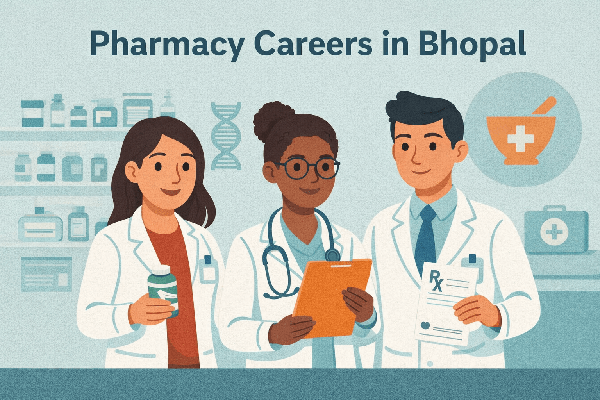
For the future pharmacists of People’s Campus, Bhopal — keep going.
Sources:
- BioSpectrum India — AI Takes India Pharma Reins (April 2026)
- IMARC Group — AI Transforming India Pharmaceutical Industry (2025)
- IBEF — Government Initiatives Boosting Healthcare Industry in India (Feb 2026)
- IBEF — India’s Healthcare Revolution Through Telemedicine (Sep 2025)
- BW Healthcare World — AI Seen as Key to Indian Pharma’s Innovation Leap (Feb 2026)
- APAC News Network — Digital Healthcare in India: What 2026 Holds (Feb 2026)
- Sify — From Generics to Genius: The AI Revolution Reshaping Indian Pharma (Sep 2025)