
What the programmes actually cover, who can get in, what the industry looks like right now and where a media degree from PIMS takes you.
What PIMS is and why media in 2026 is a different conversation
PIMS stands for People’s Institute of Media Studies. It is the media and journalism school within People’s University Bhopal and it has been running media education in Central India for over 20 years, placing it among the oldest media institutes in Madhya Pradesh.
India’s media and entertainment industry crossed ₹2.5 lakh crore in 2023 and is projected to reach ₹4 lakh crore by 2026, according to FICCI-EY data. Digital content alone grew by 25% in 2024. Every news channel, OTT platform, advertising agency, public relations firm and corporate communication team is hiring people who can report, produce, edit and manage content across multiple platforms simultaneously.
Twenty years ago, a journalist wrote. A broadcaster presented. A PR professional managed press. A content creator was not even a job title. Today the same person does versions of all four before lunch. The media landscape did not just change; it folded in on itself. Print, broadcast, social, digital and corporate communication now run through the same hands at the same time. A media education that still keeps these in separate lanes is sending students into a converged industry with a divided skill set. That mismatch shows up fast once they are actually on the job.
PIMS built its curriculum around that reality before most institutions in the region acknowledged it existed.
PIMS programmes — quick reference
| Programme | Duration | Level |
| B.Sc. Media and Journalism | 3 plus 1 year | Undergraduate |
| MAJ — Master of Arts in Journalism | 2 years | Postgraduate |
| MAMC — Master of Arts in Mass Communication | 2 years | Postgraduate |
| MAAPR — Master of Arts in Advertising and Public Relations | 2 years | Postgraduate |
| MABJ — Master of Arts in Broadcast Journalism | 2 years | Postgraduate |
Who can apply
For B.Sc. Media and Journalism, Class 12 from any recognised board in any stream. Science, Commerce or Arts — no subject restriction at the secondary level.
For all four postgraduate programmes — MAJ, MAMC, MAAPR and MABJ — a Bachelor’s degree from any recognised university in any stream is the baseline requirement.
Media education does not restrict entry by subject background and that is intentional. Journalists, content creators, broadcast producers and PR professionals come from every kind of academic history. What matters at the application stage is aptitude and intent, not which subjects were studied in Class 12.
At PIMS, People’s University Bhopal, admission follows the university’s selection process. Go through the eligibility criteria page before applying — document requirements and intake specifics for 2026 are worth confirming directly before you fill the form.
Syllabus – what the programmes actually cover
B.Sc. Media and Journalism
Foundation year covers Introduction to Mass Communication, Media Writing, Photography Basics, History of Journalism, Computer Applications in Media, Communication Theory.
Second and third year moves into News Reporting and Editing, Broadcast Journalism, Digital Media Production, Video Editing, Radio Production, Advertising Fundamentals, Public Relations and Media Law and Ethics.
The plus one year is a dedicated industry internship — students spend time in actual media organisations, newsrooms, production houses and agencies before graduating.
Postgraduate programmes
MAJ covers Advanced Reporting, Investigative Journalism, Feature Writing, Editorial Management, Data Journalism and Research Methods.
MAMC covers Communication Research, Corporate Communication, Media Management, Development Communication, Integrated Marketing Communication and Media Planning.
MAAPR covers Advertising Strategy, Brand Management, Campaign Planning, Event Management, PR Tools and Techniques, Crisis Communication and Digital PR.
MABJ covers Television News Production, Anchoring and Presentation, Studio Production, News Camera Operation, Documentary Making and OTT Content Production.
Specialisations available across programmes
Print Journalism, Electronic Media, Radio, Advertising, Public Relations, Corporate Communication, Digital Media, Broadcast Journalism.
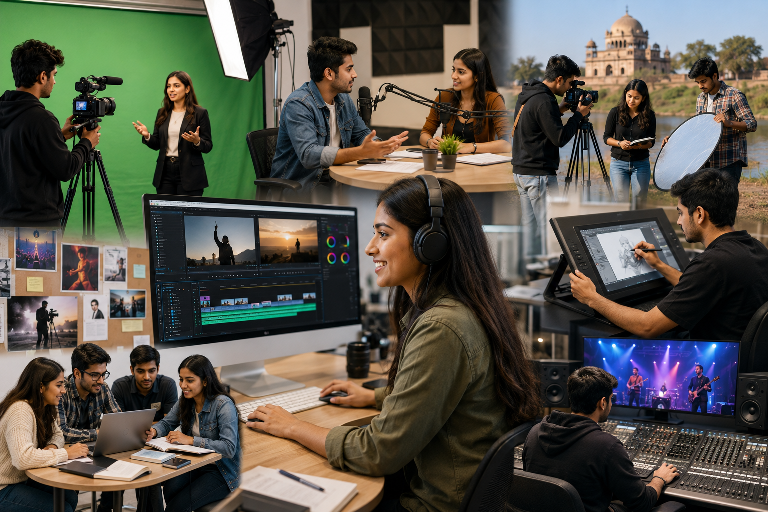
All practical work runs through PIMS’s own infrastructure — fully equipped media labs, advanced editing studios, camera and production units, newsroom simulation environment and a media-focused library. Students work on real equipment from the first semester, not from the final year.
Admission process for 2026
- Application submitted through the university admissions portal
- Academic merit evaluated on previous examination performance
- Aptitude assessment or interview depending on the programme
- Document verification covering marksheets and identity documents
- Seat allocation based on merit and programme preference
- Fee payment within the deadline to confirm the seat
For PIMS admissions 2026 at People’s University, current intake details are on the portal. Media seats at established institutes fill faster than most students expect. Apply in the first cycle, not the last.
What PIMS actually brings to these degrees
Twenty years of media education in Central India means something concrete. Alumni working across print, broadcast, digital, advertising, public relations and corporate communication. A faculty team with both academic credentials and industry experience. Infrastructure that gets used, not displayed.
Internships and live projects run through all programmes, placing students in working newsrooms, production houses, advertising agencies and PR firms during the degree. The placements record at PIMS and the alumni section are worth reviewing in full before comparing with other institutes. Where graduates actually went is the most honest measure of what a media programme delivered.
Career options after a PIMS degree
| Job Role | Work Setting | Salary Range |
| Reporter and Correspondent | Print, TV, Digital News | 3 to 7 LPA |
| Video Producer and Editor | OTT, YouTube, Broadcast | 4 to 9 LPA |
| Content Creator and Strategist | Digital Agencies, Brands | 4 to 8 LPA |
| Public Relations Executive | PR Firms, Corporates | 4 to 8 LPA |
| Advertising Copywriter | Ad Agencies | 3 to 7 LPA |
| Broadcast Journalist | News Channels, Radio | 4 to 8 LPA |
| Corporate Communication Manager | Companies across sectors | 5 to 10 LPA |
| Social Media Manager | Brands, Startups, Agencies | 4 to 8 LPA |
Digital media is where the fastest growth in hiring is happening. OTT platforms, YouTube channels with serious production budgets, branded content studios and digital news organisations are all building teams. A media graduate with strong video production and digital content skills in 2026 is entering a market that did not exist at this scale five years ago.
Broadcast journalism remains a strong and consistent track. Hindi news channels, regional television and national broadcasters run regular hiring cycles and entry-level journalists with practical training move through those cycles faster than those without it.
Public relations and corporate communication climb fastest in compensation. Senior PR professionals and communication heads at large companies command significant packages and the path from a postgraduate media degree to those roles is more direct than most people outside the field realise.
Advertising — traditional and digital — continues hiring writers, strategists and creative professionals from media and mass communication backgrounds. The advertising industry in India crossed ₹1.1 lakh crore in 2024. The demand for people who understand brand communication is not slowing.
Should you pick this
Media is one of those fields where what you build during the degree matters as much as the degree itself. The portfolio, the internships, the stories reported, the videos produced, the campaigns worked on — all of it goes into every interview. A media graduate with a real body of work from college is in a completely different position from one who only sat in classrooms.
Before choosing any media institute, find out whether students work on real equipment from the first semester or wait until final year to touch a camera. Ask about internship quality and whether the college places students in working organisations or just issues certificates. Go through the last three batches of alumni and see what they are actually doing now.
Those questions matter more than any ranking number on a comparison website.
Explore all programmes at PIMS, People’s University Bhopal or apply directly at admissions.peoplesuniversity.edu.in for the 2026 intake.