
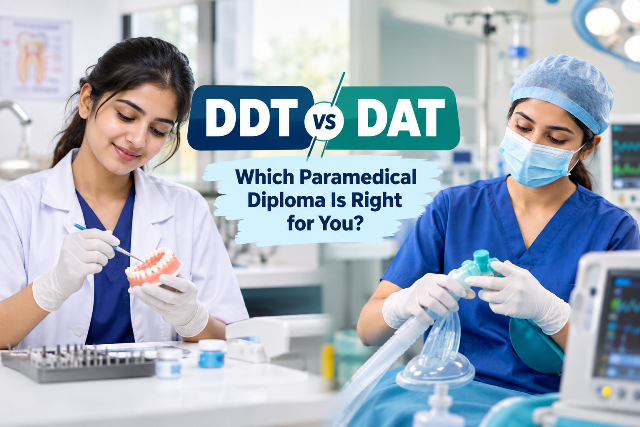
A simple comparison for students confused between these two courses
Just finished 12th with Science and now stuck between two course names that sound nothing alike but somehow keep showing up in the same breath? DDT and DAT, both two-year diplomas at PCPS, People’s University, Bhopal, both approved by the MP Paramedical Council. People lump them together a lot, probably because they’re both diplomas with similar fees, but once you actually look at what each one trains you to do, they’re pretty far apart.
DDT, or Diploma in Dialysis Technician
This is the course for anyone who wants to work with patients on dialysis, basically people whose kidneys have stopped functioning the way they should. You’ll end up learning how dialysis machines actually work, how to get a patient ready before their session starts, what to watch for while they’re connected to the machine, and how to keep the whole setup running safely.
There’s genuine, steady demand here too. Kidney problems are fairly widespread across the country, and that means dialysis centres and hospitals are always on the lookout for people who actually know what they’re doing with this equipment.
DAT, or Diploma in Anesthesia Technician
Now this one’s a different world entirely, the operation theatre. You’re assisting anesthetists before and during surgery, prepping the anesthesia equipment, keeping watch on patients while they’re under, and staying ready in case something needs quick attention mid-procedure.
Honestly, if the thought of being in the room during actual surgeries, working alongside doctors when it genuinely matters, sounds exciting rather than nerve-wracking, this course is probably where you belong.
How They Actually Stack Up
Duration’s the same for both, two years. Eligibility’s the same too, 10+2 with Science gets you in either door. Fees are almost identical as well, DMLT and DDT sit at ₹52,000 a year, DAT’s barely higher at ₹52,800. So no, this isn’t a case of one being easier to get into than the other. It genuinely comes down to what kind of work pulls you in.
Dialysis work tends to be calmer, more predictable, the same kind of routine most days. OT work moves faster, and it asks a lot more of you in terms of staying alert for long, sometimes unpredictable stretches.
Life After the Diploma
Finish DDT, and you’re probably headed toward a dialysis centre, a nephrology department, or a hospital’s kidney care unit. There’s a rhythm to this work that a lot of people actually prefer.
Finish DAT, and operation theatres, ICUs or anesthesia departments are more likely where you land. Surgeries rarely go exactly as planned, so you learn pretty quickly how to stay calm when things shift unexpectedly.
So Which One’s Actually For You?
Try this question instead of overthinking it. Would you rather see the same patients again and again, the way dialysis care works, or be right there in the operation theatre while a surgery’s happening?
If you like knowing what your day looks like before it starts, DDT’s your answer. If pressure doesn’t scare you off, and you actually want to be close to surgical work, go with DAT.
There’s no wrong pick between the two. Both are roles a hospital simply cannot run without, and students doing either diploma at PCPS get real, hands-on training at People’s Hospital, a 1,500-bed hospital sitting right there on campus. That kind of early exposure teaches you more than any textbook ever could.
Getting In
Both courses ask for 10+2 with Science, and admission runs on merit. Everything you need is on the eligibility criteria page, and you can apply directly through the admissions portal.
Still torn between the two? Enquire now and talk it through with the PCPS admissions team before you make up your mind.