The world’s biggest industries are no longer guessing. They are running live digital copies of everything physical and making decisions in real time. Here is what that means for the economy, for careers, and for students choosing their field right now.
Nobody saw this coming ten years ago.
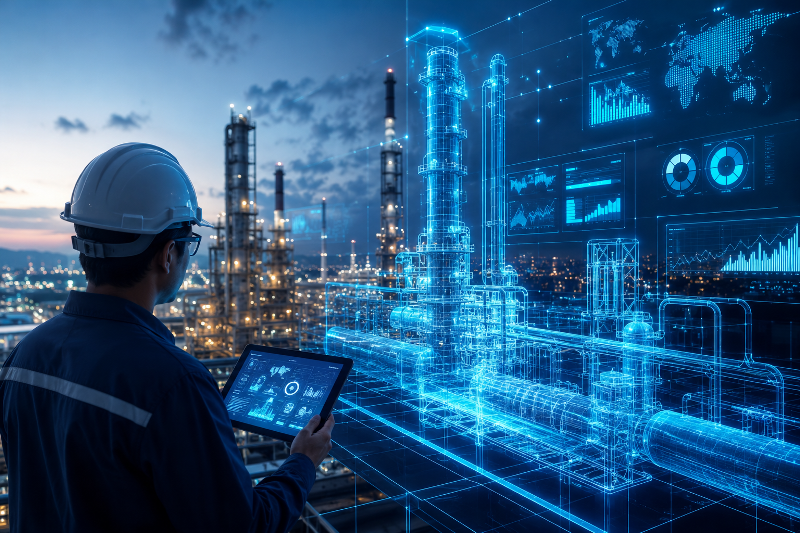
A crane on a construction site. A turbine spinning offshore. A patient on an operating table. All of them now have a live digital copy running on a server somewhere, pulling real data, catching problems before they become disasters.
That is a digital twin. Not a simulation. Not a 3D render. A connected replica that updates as the real thing changes.
In 2026 this is not pilot project territory. Companies are running core operations on it.
The numbers tell the story
The global digital twin market sat at 17.4 billion dollars in 2024. It is projected to cross 259 billion dollars by 2030. That kind of growth does not happen without serious money moving behind it.
Over 70 percent of large manufacturers worldwide have deployed or are actively piloting digital twin programmes. The patient twin market in healthcare alone is expected to hit 5.9 billion dollars by 2029.
This is where capital is going. That matters.
Manufacturing
BMW does not build a new assembly line without running it as a digital twin first.
Every robot arm, every conveyor, every worker pathway gets tested virtually before a single piece of equipment is ordered. Problems get caught in the model before they cost anything in the real world.
Siemens runs over 1.5 million digital twins across its global manufacturing operations. Machines flag wear days before they fail. Maintenance crews show up on schedule instead of during a breakdown at 2 AM.
For mechanical and production engineering students this is the floor they are walking onto after graduation. Knowing how to fix a machine after it breaks is one skill. Understanding predictive systems before the break happens is another. Industry wants the second one now.
Healthcare
Hospital Clínic in Barcelona ran one of the earliest documented programmes where surgeons rehearsed cardiac procedures on a digital twin of the actual patient’s heart before operating.
That is standard thinking now. Medtronic, Philips, and Siemens Healthineers are all building patient twin platforms. The FDA has started drafting regulatory frameworks specifically around digital twin use in surgical planning and medical devices.
For medical, nursing, and pharmacy students the shift is already inside the hospitals they will enter. Clinical data, imaging, and live vitals feed models that support decisions. The professional who understands both the patient and the data layer behind them is the one hospital will want.
At People’s University, Bhopal, students train inside a live teaching hospital with over 1,500 beds covering medicine, surgery, and allied health from early in the programme. That daily clinical exposure is what connects education to where healthcare is actually heading.
Civil Engineering and Infrastructure
Singapore has maintained a city scale digital twin called Virtual Singapore since 2018. Every building, road, utility line and green space mapped with live data on top. Planners test disaster scenarios and infrastructure changes virtually before touching anything physically.
Closer to home, Smart City Mission projects in Pune, Indore and Bhopal are incorporating digital twin frameworks into urban planning and utility management. This is not imported technology sitting in a presentation. It is being built into how Indian cities grow right now.
For civil engineering students, BIM integration and sensor linked structural monitoring are becoming expected from day one on site, not something to pick up later.
Energy
The offshore oil and gas industry loses roughly 38 billion$ every year to unplanned equipment failures. Digital twins of offshore platforms have cut unplanned shutdowns by up to 25 % in documented deployments by BP and Shell.
Vestas, one of the largest wind turbine manufacturers in the world, runs digital twins of its turbines across multiple countries, adjusting performance remotely and catching failures months before they happen.
What students should take from all this
Every industry above needs people who understand both the physical system and the digital layer running on top of it.
That is not only a computer science conversation. An engineer must comprehend the nature of what is really happening within the machinery before they can construct an accurate model. A physician needs medical insight to make sense of the data. The civil engineer requires an understanding of the structural behavior before he can build a twin of it.
The students who succeed in such a climate have come from an environment where reality and its associated processes were integral to their training.
This is something that happens at People’s University which integrates engineering, medicine, pharmacy, and management into an 84-acre campus featuring hospitals, laboratories, and industrial exposure, as well as academia.
To know what programmes are available and what suits your goals, start at the admissions page.
The technology is not on its way. It is already here and industries are running on it hard. The only question worth asking is whether the people entering these fields are ready for it or spending their first two years at work trying to catch up.
That answer starts with where you choose to study.