Something worth thinking about before choosing a degree.
Every few months, a new capability gets added to artificial intelligence, it writes code, clears entrance exams, drafts legal briefs, generates medical reports. The progress is real and it is not slowing down. For a student deciding what to study, this creates a genuine and reasonable question: what kind of education actually holds its value in this environment?
The answer is less complicated than it seems.
What AI Does Well and Where It Stops
Artificial intelligence is extraordinarily good at processing large amounts of information quickly, identifying patterns and producing outputs based on existing data. These are not small capabilities. They are genuinely powerful and they are already displacing certain categories of routine work.
But there is a boundary.
AI cannot interpret the contextual implications that humans can. It lacks the understanding that comes from being involved in a stressful conversation or feeling the tension that exists between two parties in a negotiation or knowing why something is technically right but socially unacceptable.It cannot exercise moral judgment in a situation where the rules run out. It cannot lead people through uncertainty when there is no formula to follow.
These capabilities are not technical. They are deeply human and they are built through the study of human thought, behavior, society and language.
That is precisely what Humanities education develops.
What a Humanities Student Actually Learns
A Psychology student develops the ability to understand why people make the choices they do, not just what they choose, but the motivations, fears and social pressures that shape every decision. This understanding is not abstract. It becomes a professional tool in every field that involves working with people, which is nearly every field.
A History student learns to recognize patterns that the crises, conflicts and policy failures of today rarely appear without precedent. The ability to read the present through the lens of the past is a rare analytical skill and it is one that consistently distinguishes strong thinkers from average ones.
A Political Science student understands how institutions, power and public decision-making actually function, not in theory, but in practice. In a country with growing civil services, policy research and governance sectors, this knowledge has direct and substantial career value.
The English student realizes that language is the main tool that will be used in order to communicate thoughts, earn the trust of another party and exert influence over others. The skill of expressing one’s thoughts clearly has become a valued trait in today’s workplace.
The Scarcity That Is Coming
This is the part of the conversation that most students and families have not fully considered yet.
Across India, thousands of colleges are currently producing graduates who are trained to work alongside AI tools to use them, operate them and feed them inputs. Within a few years, that supply will be very large and as any Economics student knows, compresses value.
The graduate who can do something different, who can evaluate what the AI produced and determine whether it is actually right for the humans involved, who can build the trust that technology cannot manufacture, who can ask the question the algorithm never thought to ask, that person is not being produced in large numbers.
And they will not be, because this kind of thinking cannot be taught quickly or replicated easily. It is built over years of serious intellectual engagement with human complexity.
Scarcity, in any market, commands a premium. That will be as true for thoughtful, well-trained Humanities graduates in 2030 as it is for any other rare professional skill today.
Where This Degree Takes You
Civil services continue to be one of the best career choices available to graduates in Humanities and there is more than good reason for this, as the UPSC and MPPSC are essentially built on topics like History, Political Science, Psychology, etc. In addition, other careers like policy research, media work, human resources management, teaching, development work, etc., regularly make use of this field.
What connects these paths is not a single subject. It is a way of thinking analytical, ethical, contextually aware, and grounded in an understanding of how people and societies actually work.
A Final Thought
The most relevant students in the coming decade would not be the ones who knew how to use the maximum number of tools. Instead, they would be the ones who knew when these tools were insufficient and knew what to do in such a situation.
That judgment has a home.
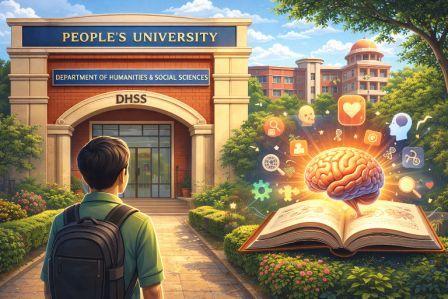
The Department of Humanities and Social Sciences at People’s University, Bhopal offers BA and MA programmes in Psychology, English, History and Political Science. Admission is merit-based, with no entrance examination required.
If this way of thinking feels familiar to you, it is worth exploring seriously.