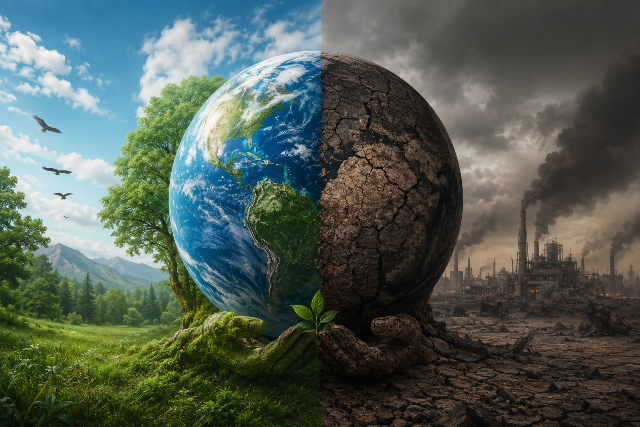
Every 5th of June, the world collectively decides to care about the planet for approximately 24 hours. Social media fills up with green graphics. Schools hold tree-plantation drives. Corporates put out press releases about “sustainable futures.” And then the 6th arrives and things go back to normal.
This is not that kind of blog post.
This is an honest talk, we need to have it not just on World Environment Day, but every other day too. You know, every time we toss a plastic bottle from a car or let the tap run while brushing.
We’re students, teachers, professionals, regular folks in a place where the Ganga River has spiritual importance. People look up to it for reverence, yet its waters now do more than displease, they horrify. Our same land has Bhopal’s Upper Lake that shimmers during winter sunrises. At the same time, Bhopal shows the world’s worst industrial accident site from 1984, taking many lives and poisoning folks and soil long-term. The disaster happened because executives valued money way more than proper safety steps.
That lesson never fully left us. It never should.
What Are We Actually Talking About?
World Environment Day has been observed since 1972, when the UN decided the planet needed at least 1 day of global attention. 50+ years later, the problems that prompted that decision have only deepened. The theme revolves around restoring land and ecosystems, which is a formal way of saying – we have broken quite a lot and now we need to try to fix it.
But here is the thing about restoration. It is slow. A forest that took centuries to grow does not come back in a plantation drive. A river that has been polluted for decades does not run clean because a few NGOs cleaned a stretch of its bank. These are long, unglamorous, patient processes and they require people who are trained, committed and genuinely invested in outcomes they may not live to fully see.
That is where universities come in. Not just on World Environment Day. Every single year.
Why This Matters at People’s University
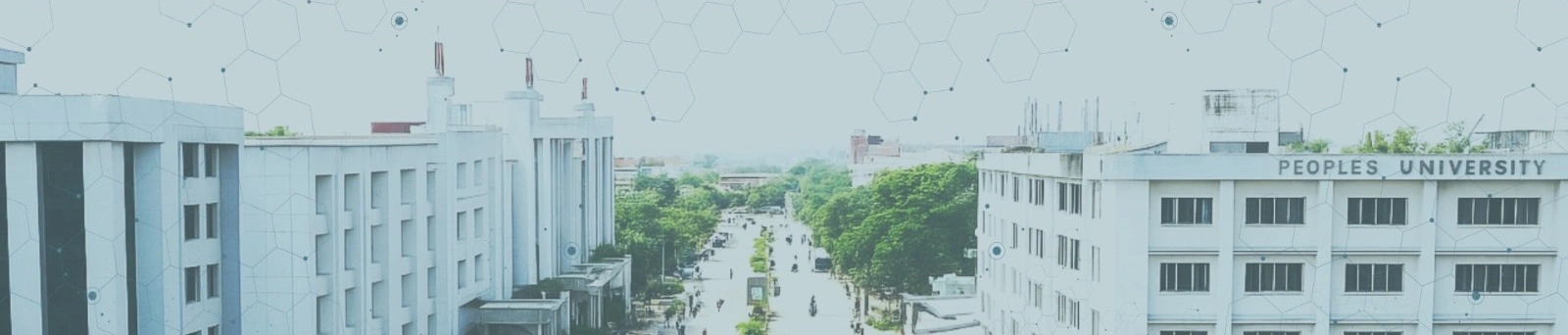
People’s University sits on an 84-acre campus in Bhopal – the City of Lakes. That is not incidental. The PU campus itself is green, spacious and alive in a way that many institutions are not. There are trees here that have been standing longer than some of our students have been alive.
But the more important point is what happens inside the classrooms and labs.
Students in our School of Research & Technology(SORT) are learning to build things, systems, structures, technologies. How those things are built, what they consume, what they leave behind, these are environmental questions as much as engineering ones. Students at our Centre for Scientific Research & Development(CSRD), working in Biotechnology and Microbiology are literally studying the living systems that make this planet function. Students at our School of Pharmacy(SOPR) are learning about substances that, handled irresponsibly, become the pharmaceutical pollution now showing up in groundwater around the world.
Every single discipline here has an environmental dimension. The question is whether we choose to see it.
A student at our People’s Institute of Legal Studies(PILS) can become the lawyer who wins an environmental case in the National Green Tribunal. A student at our People’s Institute of Media Studies(PIMS) can become the journalist who breaks the story of illegal mining in a protected forest. A student at our People’s College of Medical Sciences(PCMS) will treat patients whose illnesses are directly connected to air quality, contaminated water, or industrial exposure.
You do not need to be an environmental science student to work for the environment. You just need to understand that the world you are being trained to work in is the same world that is warming, flooding, and running out of clean water.
Bhopal Taught Us Something
There is a particular weight to talking about environmental responsibility from this city.
Bhopal is gorgeous. Genuinely. The lakes, the hills, the Van Vihar, there is real beauty here. It is also the city where, on a December night in 1984, a Union Carbide factory leaked methyl isocyanate into the air and thousands of people died in their sleep. Hundreds of thousands more were injured. The effects passed from one generation to the next.
It was the kind of disaster that should have changed everything.
It changed some things. It changed some laws. It changed how some companies talk about safety. But walk through the areas still affected by that contamination and you will understand quickly that the lesson has not been fully learned. Not here, not anywhere.
The environment is not an abstract cause. It is a neighborhood. It is a family. It is lungs and liver and skin.
We study at and work within an institution that is committed to health — medical, pharmaceutical and otherwise. Our 1500 bedded hospital treats real people with real ailments. Many of those ailments have environmental roots. Pollution-linked respiratory illness. Waterborne disease. Heat-related conditions that are becoming more frequent as summers grow more brutal. The connection between environment and health is not theoretical in this part of the world. It is in the wards.
So, What Do We Do?
This is usually the part where a blog like this gives you a numbered list. Ten things you can do for the environment. Carry a tote bag. Use a reusable bottle. Take shorter showers.
Those things are not wrong. They are just not enough by themselves, and listing them out often lets institutions and systems off the hook by making environmental responsibility entirely personal.
So instead, this: whatever you are studying, think about what your field owes the planet. Not in a guilt-ridden way, in a practical, professional way. What does responsible practice look like in your discipline? What does it look like to do your job well and also do it sustainably? These are not opposing goals. They are, increasingly, the same goal.
If you are interested in exploring what responsible, research-driven education looks like across these disciplines — People’s University’s programmes are open for 2026 admissions. This is a place that takes the connection between education and the larger world seriously.
A Last Thought
The Earth is 4.5 billion years old.
And the version of us that actually started damaging it, industries, pollution, deforestation, that is barely only 200 years old.
200 years of damage to a 4.5-billion-year-old planet.
We are not the owners here. We are guests who overstayed and trashed the place.
World Environment Day is just a reminder of that. A small nudge to look around and ask are we being responsible? Are we even paying attention?
At People’s University, we prepare students for the real world. And honestly, the real world right now needs people who think beyond just their careers. It needs people who notice. Who question. Who choose differently.
That starts here. That starts now.
Happy World Environment Day from People’s University, Bhopal.
Visit us at peoplesuniversity.edu.in | Admissions: admissions.peoplesuniversity.edu.in | Call: 9538500200