
कृष्णं वन्दे जगद्गुरुम्
(Krishnam vande jagadgurum — I bow to Krishna, the teacher of the world)
Most people know Krishna was born at midnight. Fewer people actually stop and think about what that night looked like for his parents.
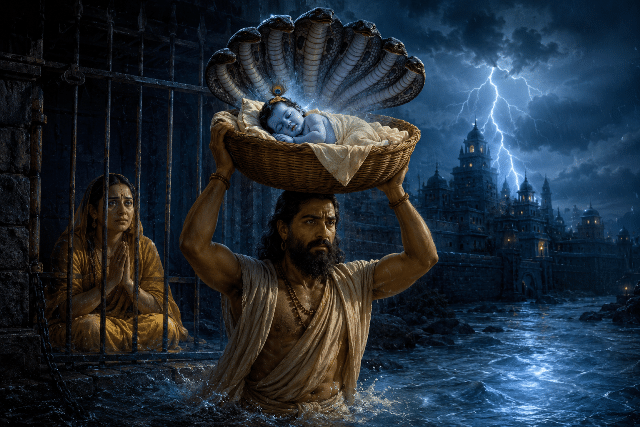
Devaki and Vasudev didn’t get a hospital room or a quiet moment with their newborn. They were locked up, in a prison cell, because Devaki’s own brother Kansa had been told a prophecy said her eighth child would kill him. Six children before Krishna had already been taken from her at birth. So when Krishna arrived, at midnight, there wasn’t time to celebrate. Vasudev picked him up almost immediately and walked out into a storm, crossing a river that was flooding badly enough that legend says it rose to touch the baby’s feet before settling back down.
That’s the story most festivals gloss over. Janmashtami isn’t really a birthday party. It’s the anniversary of a father risking everything, in the middle of the night, to keep his son alive.
Five things about Krishna that most people never really learn
He had over a hundred names. Vasudeva, Govinda, Madhava, Keshava — people use half of these in daily conversation without even realising they’re all him.
He was the eighth child of Devaki and Vasudev, and that’s the actual reason Janmashtami falls on the eighth day of the lunar fortnight. Not a random date. Tied directly to his birth order.
The Bhagavad Gita isn’t its own separate scripture. It’s a conversation, just one conversation, between Krishna and Arjun, standing on a battlefield minutes before a war neither of them wanted to fight.
Dwarka, the city Krishna is said to have built and ruled later in life, has real underwater ruins off the Gujarat coast that marine archaeologists have been examining for decades. Myth sitting right next to actual excavation data.
He never picked up a weapon during the war at Kurukshetra. He chose to be Arjun’s charioteer instead, meaning the most decisive figure in that entire war spent it holding the reins, not a bow.
A shloka worth sitting with for a second
कर्मण्येवाधिकारस्ते मा फलेषु कदाचन।
मा कर्मफलहेतुर्भूर्मा ते सङ्गोऽस्त्वकर्मणि॥
Roughly – you only have a right to the work, never to what comes out of it. Don’t work purely chasing the outcome, but don’t stop working either.
Chapter two, verse forty-seven of the Gita. Probably the single most repeated line in Indian philosophy, and it hits harder in college than it ever did back in school – staring at a bad result sheet, a placement interview that didn’t go anywhere, or a project you put weeks into that just didn’t land the way you hoped.
Why the stories land differently once you’re actually in college
In school these read like bedtime stories. Somewhere around college they start sounding more like something someone’s genuinely telling you, for real, not just narrating.
Krishna wasn’t teaching Arjun how to win. He was telling him to just do the work honestly and stop spiraling over what happens after. That’s a strange kind of comfort when your own semester is going sideways.
There’s also something in young Krishna stealing butter, getting caught every single time, and somehow still being forgiven, that resonates with students figuring themselves out away from home, a lot of them for the first time. Nobody actually expects a college student to have it all together. Even his own stories don’t pretend anyone should.
How the night usually plays out
Fasting is still common through the day. Some keep it strict, others just stick to fruit and milk until the midnight aarti.
The idol gets bathed, dressed, and placed in a small decorated cradle right at midnight, bells and conch shells going off the moment it’s done. Bhajans run late into hostel common rooms, and at some point they just turn into a dance session with zero proper form and a lot of enthusiasm.
The next morning is usually Dahi Handi – a pot of curd hung somewhere on campus, everyone climbing on top of each other trying to build a shaky human pyramid to reach it. Half devotion, half finding out which friend can actually hold your weight on their shoulders without complaining halfway up.
And then there’s the actual chaos of campus that evening
Someone’s out hunting for a mud pot at 6 pm. Someone’s arguing about how high the dahi handi should be hung this year, again. By evening half the hostel smells like fresh makhan because nobody can wait for the aarti before tasting it. Hostellers, day scholars, people who’ve barely sat through a full puja before — everyone somehow ends up in the same common room by midnight, without anyone officially organising any of it.
What it looks like at People’s University
Between the student clubs running through the year and whatever energy campus already carries around a festival, Janmashtami here usually turns into more than just one evening. Music club leads most of the bhajans. Literary club puts together a short reading or skit. Photography club is out the next morning chasing the Dahi Handi chaos trying to get one good shot.
Events like this show up fairly often on the latest activities and events page. And for anyone curious where it all actually happens — the hostels, the open grounds, the auditoriums for the bigger gatherings — the campus facilities page gives a decent idea.
One last line to carry forward
यदा यदा हि धर्मस्य ग्लानिर्भवति भारत। अभ्युत्थानमधर्मस्य तदात्मानं सृजाम्यहम्॥
Whenever things go out of balance, Krishna tells Arjun, something rises to fix it again. Most students won’t remember every fact from this by next semester. But the ones who actually sit through the stories, listen properly, and stick around for the midnight aarti usually walk away with something quieter than trivia — some sense that just showing up honestly, semester after semester, counts as its own kind of dharma.