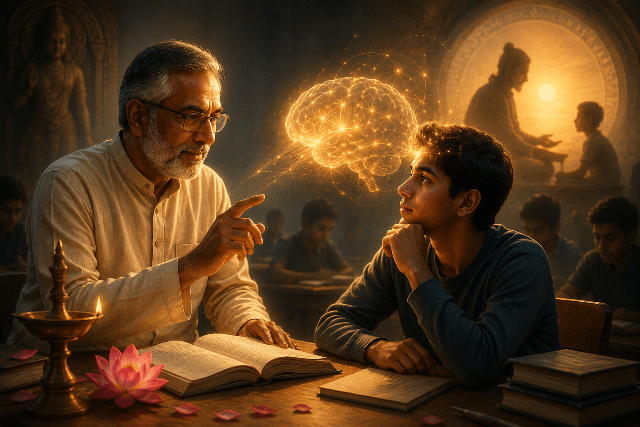
What actually happens inside a student’s head when a great teacher is in the room and why it takes years to notice
People’s University | Bhopal | July 29, 2026
There was that one teacher. You know the one.
Not the one who was strict. Not the one everyone was scared of. The one who came in, put their bag down, looked at the class and said something that made you sit up slightly without knowing why. The one whose period somehow felt shorter than everyone else’s. The one you did not fully appreciate at the time because you were fifteen and had other things going on.
You probably did not think much about them then. You might think about them now more than you expect.
That is not a coincidence. Something was happening in that classroom that you had no framework to understand at fifteen. You do now.
Your brain was being rewired and nobody told you
When a student encounters a teacher who genuinely engages them — who makes the material feel like it matters, who asks questions that do not have one correct answer, who pushes back when the student is being lazy with their thinking — something measurable happens in the brain.
The prefrontal cortex, the part responsible for reasoning, decision-making and the ability to think about thinking, becomes more active. New neural pathways form. The brain is not just receiving information. It is being stretched into configurations it would not have reached on its own.
This is what a great teacher does that a textbook cannot. A textbook delivers content. A teacher creates the conditions under which a brain grows. Those are not the same thing and the difference between them is the difference between a student who passes their exams and one who can actually think ten years after the exams are over.
The teacher you ignored in Class 9 was doing the second thing. Quietly. Without you noticing. Probably without adequate appreciation from anyone in the room.
The Guru Purnima connection — and why it is older than you think
Guru Purnima falls on July 29 this year, the full moon of Ashadha, observed across Hindu, Buddhist and Jain traditions as the day dedicated to honouring teachers and mentors. The Sanskrit word Guru breaks down simply — Gu means darkness, Ru means the one who removes it. A Guru is not a person who delivers a lecture. The tradition defines them as someone who removes ignorance and moves a student toward understanding.
India has held this understanding for thousands of years. The teacher-student relationship was considered sacred not because of sentiment but because of something the tradition had observed long before neuroscience had the language for it — that learning is not a transaction. It is a transformation. And transformation requires another person to hold the conditions while it happens.
The modern world has been slow to catch up to what that means practically. We measure universities by their rankings, their infrastructure, their placement packages. We do not measure them by the quality of attention their faculty give to students. We probably should.
What the backbencher actually understood that nobody credited them for
Here is something worth saying plainly. The student at the back of the classroom is usually not disengaged. They are selectively engaged. They are watching the room more than the board. They are deciding, continuously, whether what is happening in front of them is worth their attention.
When a great teacher walks in, the backbencher notices. Not always consciously. But they notice when someone actually knows what they are talking about and cares whether the room follows. They notice when the energy in a classroom is different from the standard one. They lean in slightly, even when they are pretending not to.
That noticing is itself a form of intelligence. The ability to read a room, to evaluate authenticity, to distinguish between someone going through the motions and someone who is genuinely present — these are skills that show up later in careers, in leadership roles, in any situation that requires reading people accurately.
The backbencher did not always get the marks. They were, in many cases, getting something else entirely.
What this means for choosing where to study now
If you are a student in 2026 choosing a university, the question worth asking is not just what the campus looks like or what the placement brochure says. It is who is going to be teaching you.
Because the content of any degree is available online. The curriculum is searchable. What is not available anywhere except inside an actual institution is the faculty member who reads your work seriously, who challenges you when your thinking is sloppy, who has spent enough time inside the industry you want to enter that they can tell you the things no textbook has caught up with yet.
At People’s University Bhopal, the faculty across engineering, law, management, health sciences and pharmacy carry both academic credentials and real professional backgrounds. The combination matters because a teacher who has only ever taught is a different resource from one who has also done the thing they are teaching. Students notice the difference, even from the back row.
The thank you that never got said
Most people have a teacher they never properly thanked. The one who saw something in them before they saw it in themselves. The one who made a subject click in a way that changed what they thought they were capable of. The one who stayed after class not because they had to but because the question was worth answering properly.
Guru Purnima exists because that debt is real and because acknowledging it matters — not just for the teacher who receives the acknowledgment but for the student who gives it, who in the act of recognising what they received also recognises something about who they are now because of it.
If that teacher comes to mind today, they probably should.
People’s University Bhopal — building the kind of university where students remember their teachers long after graduation. Admissions 2026-27 are open.