B.Sc. Biotechnology course details 2026 — full form, eligibility, admission, syllabus and career scope
What the undergraduate degree covers, what seven specialised research labs at CSRD offer and where three years at People’s University takes you.
People’s University | Bhopal | 2026
What B.Sc. Biotechnology actually is and why this is the right time to start
B.Sc. Biotechnology. Three years. Six semesters. The undergraduate degree that takes a science student from 12th standard biology into the applied world of genetic engineering, bioprocessing, molecular diagnostics, bioinformatics and pharmaceutical biotechnology.
India’s biotechnology sector crossed ₹4 lakh crore in 2024 and is moving toward ₹28 lakh crore by 2030. Government investment through the BioE3 policy is pushing biotech R&D and manufacturing deeper into the national economy. Serum Institute, Biocon, Dr. Reddy’s, Cipla Biologics, Sun Pharma and hundreds of smaller biotech and diagnostic companies are expanding operations that need trained science graduates at every level of the pipeline.
The difference between a student who did biology in 12th and one who completed B.Sc. Biotechnology is not just three years. It is the difference between knowing that genetic engineering exists and knowing how to actually work with recombinant DNA in a lab. Between reading about immunology and running an ELISA. Between understanding that bioprocessing is a field and being trained to work inside it.
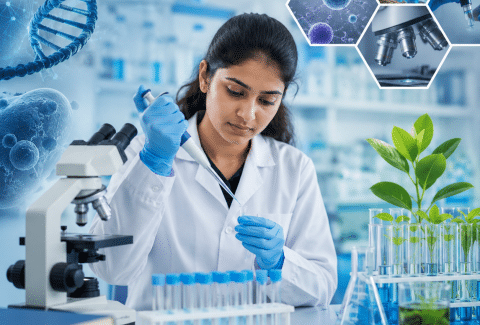
At CSRD — Centre for Scientific Research and Development, People’s University Bhopal — the B.Sc. Biotechnology programme is built around laboratory training that starts in the first semester, not in the final year. Seven specialised research labs run alongside the academic curriculum throughout the degree. Students are not waiting for a chance to enter the lab. They are in it from the beginning.
B.Sc. Biotechnology — quick reference
| Detail | Information |
| Full form | Bachelor of Science in Biotechnology |
| Duration | 3 years — 6 semesters |
| Level | Undergraduate |
| Institute | CSRD, Centre for Scientific Research and Development, People’s University Bhopal |
| Mode | Full-time with laboratory components each semester |
Who can apply
10+2 passed with Biology as a main subject. That covers students from PCB and PCMB streams from any recognised board.
Eligibility tells you the minimum. What actually matters in this programme is whether a student is genuinely drawn to how living systems work and what can be done with that knowledge in medicine, agriculture, environment and industry. Students who come in curious and willing to put real time into lab work tend to use the three years well. Students who are treating this as a fallback subject tend to find the practical intensity harder than they expected.
Admission at CSRD, People’s University Bhopal is through merit in the qualifying examination or entrance test performance, followed by counselling as per university admission regulations. Check the eligibility criteria page before applying and confirm 2026 intake details directly.
Syllabus — what the six semesters cover
Year 1 — Semester 1
Fundamentals of Biology, Basic Chemistry, Mathematics and Statistics for Biologists, Introduction to Biotechnology, Computer Applications in Biotechnology, Laboratory Practicals 1.
The first semester does something important — it does not assume that 12th biology is enough of a foundation. Fundamentals of Biology and Basic Chemistry are covered with the rigour of a science degree, not a revision class. Computer applications appear from semester one because data handling and basic computing are now part of biological science work, not an add-on for later.
Year 1 — Semester 2
Microbiology, Organic Chemistry, Cell Biology, Biochemistry Fundamentals, Environmental Studies, Laboratory Practicals 2.
Microbiology and Cell Biology in the second semester give students the two lenses that biotechnology uses most — what microorganisms do and how cells function. Biochemistry Fundamentals sits alongside these and connects the chemistry of life to the molecular level, which the semesters ahead build directly on.
Year 2 — Semester 3
Genetics and Molecular Biology, Bioanalytical Techniques, Immunology, Biophysics, Elective Course 1, Molecular Biology Laboratory.
Semester three is where the programme shifts gear. Genetics and Molecular Biology together form the scientific core of modern biotechnology. Bioanalytical Techniques puts instruments in students’ hands — the equipment used in actual labs, not described in a chapter. The dedicated Molecular Biology Laboratory this semester is where the skills start becoming muscle memory.
Year 2 — Semester 4
Recombinant DNA Technology, Plant Biotechnology, Animal Biotechnology, Enzymology, Elective Course 2, rDNA Technology Laboratory.
Recombinant DNA Technology in semester four is the subject most students feel the degree was building toward. Cutting, joining, cloning and expressing DNA — the techniques behind vaccines, insulin, gene therapies and a growing share of modern pharmaceuticals. Plant and Animal Biotechnology run in the same semester because both sectors are major employers of B.Sc. Biotechnology graduates and the science between them is connected.
Year 3 — Semester 5
Genomics and Proteomics, Bioprocess Technology, Medical Biotechnology, Bioinformatics, Research Methodology, Advanced Biotechnology Laboratory.
The fifth semester is where the degree starts looking like a career. Genomics and Proteomics connects students to where pharmaceutical and diagnostic research is currently running. Bioprocess Technology is directly relevant to manufacturing roles. Bioinformatics is the fastest-growing skill requirement across the sector. Research Methodology prepares students for both the final semester project and for M.Sc. or doctoral programmes that follow.
Year 3 — Semester 6
Pharmaceutical Biotechnology, Environmental Biotechnology, IPR and Bioethics, Entrepreneurship Development, Project Work and Internship, Comprehensive Viva Voce.
The final semester brings the degree together. Project work and internship puts students inside a real working environment — a company, a research lab, a diagnostic centre. IPR and Bioethics is there because patent rights and research ethics are not optional knowledge in a biotechnology career. They come up constantly. The Comprehensive Viva Voce tests whether students can actually explain and apply what they have studied, not just whether they cleared the semester papers.
The seven research laboratories at CSRD
This is where B.Sc. Biotechnology at People’s University differs from programmes that have the same syllabus but not the same infrastructure.
Biochemical Research Lab — enzyme assays, protein characterisation, metabolic pathway analysis.
Biotechnology and Pharmacology Lab — drug-biological system interactions, pharmacological screening of natural and synthetic compounds.
Central Instrumentation Lab — HPLC, spectrophotometry, gel documentation, PCR and advanced analytical instruments shared across research disciplines.
Human Genetic Lab — genetic disorder analysis, chromosomal studies, molecular diagnostics of human genetic conditions.
Immunology Lab — antibody-antigen interactions, ELISA, flow cytometry, immunological assay development.
Molecular Biotechnology Lab — gene cloning, recombinant protein expression, molecular marker analysis, PCR-based diagnostics.
Stem Cell Technology Lab — stem cell culture, differentiation studies, cell-based therapeutic research. Very few undergraduate programmes in Central India give students access to this during the degree years.
These are not demonstration labs maintained for inspection. They are working research environments where faculty are running active projects and where students work in real experimental conditions from semester one.
Admission process for 2026
Applications go through the university admissions portal. Selection is through merit assessment or entrance examination followed by counselling. 10+2 marksheets and certificates, age proof, and category documents where applicable are required at the time of verification.
For B.Sc. Biotechnology admission 2026 at People’s University, current intake details and examination schedule are on the admissions portal. Seats are limited — apply before the cycle closes.
What CSRD brings to this degree
Seven specialised research labs. Faculty who are active publishing researchers, not only teachers. Research projects and publications running through the centre. Collaborators across research institutions that create external exposure for students during the degree.
Workshops, webinars and conferences run through the academic year. Extracurricular activities and student achievements give a picture of what student life at CSRD actually involves beyond the formal syllabus.
Go through the HOI’s message and the vision and mission of CSRD before making a decision. And check placements at CSRD — where previous B.Sc. graduates went after the degree is the most honest measure of what the programme actually produces.
Career options after B.Sc. Biotechnology
| Job Role | Work Setting | Salary Range |
| Laboratory Technician | Diagnostic labs, hospitals, research institutes | 2.5 to 5 LPA |
| Research Assistant | Biotech companies, CSIR and ICMR labs | 3 to 6 LPA |
| Quality Control Analyst | Pharma and biotech manufacturing | 3 to 6 LPA |
| Junior Research Fellow | Government research institutes via CSIR NET | 4 to 7 LPA |
| Bioprocess Technician | Biomanufacturing and production facilities | 3 to 6 LPA |
| Medical Representative | Pharma companies | 3 to 7 LPA |
| Agricultural Biotech Associate | Agricultural biotech firms, ICAR labs | 3 to 6 LPA |
| Environmental Analyst | Environmental agencies, testing labs | 3 to 5 LPA |
| Technical Sales Associate | Biotech equipment and reagent companies | 3.5 to 7 LPA |
| M.Sc. or M.Tech. Candidate | Universities and research institutes | Fellowship based |
Pharmaceutical and diagnostic companies are the largest direct employers of B.Sc. Biotechnology graduates at the entry level. QC, production support, lab technician roles, and medical representative positions across companies like Biocon, Dr. Reddy’s, Sun Pharma and Cipla recruit from this background.
Government research institutions under CSIR, ICMR, DBT, ICAR and DRDO run project-based recruitment at the B.Sc. level. These positions often come with exposure to research environments that make subsequent M.Sc. and doctoral applications significantly stronger.
Agricultural biotechnology is a growing employer that most students underestimate. Tissue culture, crop improvement, biofertiliser and biopesticide development are active areas that directly use what B.Sc. Biotechnology covers, and the sector’s expansion is creating consistent hiring at the entry and mid level.
M.Sc. Biotechnology or M.Sc. Microbiology is the most common path after B.Sc. for students who want to go deeper into research or reach senior roles faster. B.Sc. graduates with a strong lab record from CSRD are well-positioned for postgraduate programmes at good universities, including M.Sc. Biotechnology at CSRD itself.
Should you pick this
B.Sc. Biotechnology at CSRD works for 12th PCB students who want their undergraduate degree to be a serious scientific training, not three years of theory before anything practical starts. The lab access from semester one is the thing that changes what students can actually do by the time they finish.
Most B.Sc. Biotechnology programmes teach the same syllabus. The difference is whether students spend their three years working in functional research labs with active faculty or sitting through practicals in a room with equipment that is rarely used. At CSRD, the seven labs are working environments and students are in them consistently.
Before choosing any B.Sc. Biotechnology programme, ask whether the labs are active or maintained for inspection. Find out whether faculty are publishing researchers or primarily administrators. Check where the previous batches went — into jobs, into M.Sc. programmes, into research positions. That information tells the real story of what a programme produces.
Explore B.Sc. Biotechnology at CSRD, People’s University Bhopal or apply directly at admissions.peoplesuniversity.edu.in for the 2026 intake.