
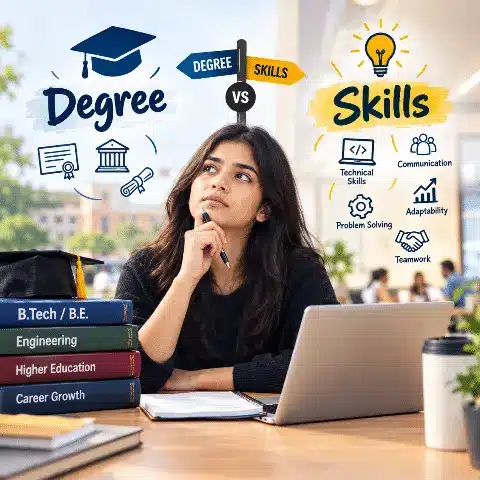
“Your degree opens the door. Your skills help you build your career.”
People’s University | Bhopal | September 2026
Every year around results season, the same argument shows up again on LinkedIn, in comment sections, in random uncle conversations at family gatherings. Does a degree even matter anymore, or is it all about skills now? Usually framed like you have to pick a side. Honestly, you don’t.
Why this question even exists
Somewhere over the last decade, self-taught developers started landing jobs at big tech companies without a CS degree. Freelancers built six-figure careers off YouTube tutorials and grit. Stories like that spread fast, and pretty soon a lot of students started wondering if college was even worth the time and money anymore.
At the same time, plenty of people with strong skills and zero formal degree still hit a wall the moment they try to get past HR screening, government exams, or roles that legally require a specific qualification. Both sides of this argument are true at once, which is exactly why it keeps going in circles online.
What a degree actually does for you
A degree isn’t just paper. At its better moments, it’s:
- Structured learning that forces you through fundamentals you’d probably skip if left to teach yourself
- A credential that opens doors legally closed without one, medicine, law, government jobs, PSU recruitment, most core engineering roles
- A campus full of people, connections that turn into references, co-founders, or just someone who tips you off about an opening later
- Time and space to actually figure out what you’re good at, through electives, projects, internships, before you’re locked into a career
The honest downside, a degree alone doesn’t guarantee competence. Plenty of graduates walk out unable to actually do the job their degree says they’re qualified for.
What skills actually do for you
Skills are what someone actually checks once you’re past the resume screening. They’re:
- Proof you can do the thing, not just that you studied it
- Something you can build and show immediately, a project, a portfolio, a working prototype, without waiting years for a certificate
- Constantly updatable, you can learn a new skill in months, a new degree takes years
- The actual currency in fast-moving fields like tech, design, content, and digital marketing, where what’s relevant changes every couple of years
The catch here too, skills without any formal grounding sometimes mean gaps nobody notices until something breaks. A self-taught developer who never learned data structures properly might ship fast but struggle the moment a system actually needs to scale.
So what actually matters more in 2026–27
Neither wins outright, and pretending otherwise isn’t honest advice. What actually works is using the degree years to build skills on top of the foundation, not instead of it.
A few ways students end up doing this well:
- Picking internships over an extra elective whenever the choice comes up
- Building actual projects during college instead of just clearing exams and moving on
- Treating certifications and workshops as additions to the degree, not replacements for it
- Using faculty and campus resources to go deeper into a skill the syllabus only touches on briefly
That last point is really where a university’s actual value shows up, not just handing out a certificate at the end, but the labs, faculty guidance, and hands-on exposure that turn a degree into something with real skill built into it.
Where this stands at People’s University
Across departments here, from engineering to management to media studies, the structure leans hard into this exact combination, formal coursework paired with internships, live projects, and practical exposure that starts well before final year. The Training & Placement Cell exists specifically to close that gap between classroom learning and what employers actually screen for. Outside the syllabus, student clubs running through the year give students a low-stakes place to actually build and test skills the coursework doesn’t fully cover.
It’s not about choosing between the degree and the skill. It’s about not wasting the years you’re already spending on one to build the other.
The real question for 2026–27 isn’t degree versus skills. It’s whether you’re using your degree years to actually build the skills that get you hired, or just waiting for the certificate to do the work on its own. If that’s the direction you’re thinking in, the People’s University homepage is a decent place to see how different departments are actually structuring that balance.