And why the spirit of Kargil lives on in every NCC cadet at People’s University Bhopal
People’s University | Bhopal | July 26, 2026
Twenty-seven years ago, on this day
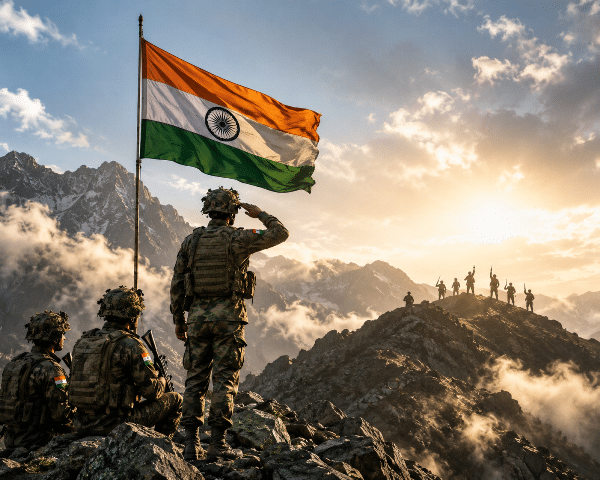
July 26, 1999. Indian Army soldiers recaptured the last of the strategic peaks in the Kargil sector of Jammu and Kashmir that Pakistani forces had occupied across the winter months. Operation Vijay was declared complete. The tricolour went back up on Tiger Hill, Tololing, point 4875 and a dozen other heights whose names most Indians knew nothing about before that summer.
527 Indian soldiers died in that operation. Thousands more were injured. Many of them were in their late teens and early twenties — the same age as the students walking into universities across India today. They went up those mountains in temperatures far below zero, at altitudes where the air itself fights against the body, carrying equipment that weighed more than most people can lift, against positions that had the geographical advantage. And they kept going.
What made them capable of that was not born in 1999. It was built across years of training, discipline and a sense of purpose that went beyond personal comfort or personal safety. The soldiers of Kargil were products of an institution — the Indian Army — that had spent years building people who could hold under conditions most of us will never face.
What Kargil actually represents beyond the history lesson
Every year on July 26, the country pauses to remember. Ceremonies are held. Candles are lit. The names of the fallen are read out. All of that matters and should continue. But Kargil Vijay Diwas carries something beyond the remembrance. It carries a question worth asking in every institution that is in the business of building young people.
What are we building them for?
The soldiers at Kargil were not just physically fit. They were mentally disciplined in a way that held under extreme pressure. They were capable of working as a unit when individual survival instinct would have made retreating the rational choice. They carried a sense of duty that was larger than their own comfort. These are not military-specific qualities. They are human qualities that training, the right environment and the right sense of purpose can build in any person willing to do the work.
Where NCC fits into this
The National Cadet Corps has been producing the civilian equivalent of that formation for over seven decades. Not soldiers necessarily — though many NCC cadets go on to join the armed forces — but people who have learned discipline through repetition, leadership through responsibility, teamwork through dependence on each other and service through showing up for something beyond themselves.
NCC training is not comfortable. Early mornings, physical drills, marching, camps, social service commitments running alongside academic work. It asks something of the students who take it on. And the students who push through that asking come out different from the ones who did not. More structured. More reliable. More aware of what they are actually capable of when the conditions are not easy.
At People’s University Bhopal, NCC is an active part of student life across departments. Students from nursing, pharmacy, engineering, law and management have all come through the NCC programme carrying something the classroom alone does not give you. The nursing college at People’s University has NCC cadets who have been honoured at national level camps. Sgt. Namrata Kumari won first prize at the National Integration Awareness Programme at the Republic Day Camp 2024. Rivika Thapa received the Best Cadet Award twice and attended three National Camps. These are not ceremonial achievements. They are the results of sustained discipline and commitment running alongside a full academic load.
What the soldiers of Kargil and the cadets of today have in common
They are not the same situation. Nobody is suggesting that a cadet’s morning drill compares to a soldier climbing Tiger Hill under fire. That comparison would be wrong and disrespectful to what the soldiers of 1999 went through.
What they share is the foundation. The willingness to show up for something bigger than immediate personal comfort. The understanding that discipline is not punishment — it is the thing that makes you reliable when the situation actually requires reliability. The experience of being part of a unit where your performance affects the people around you, which changes how seriously you take your performance.
Captain Vikram Batra, whose words “Yeh dil maange more” became the rallying cry of an entire generation, was 24 years old when he died on that battlefield. He had told his father before leaving that he would come back either with the tricolour or wrapped in it. He came back wrapped in it. And he came back a hero not because of one dramatic moment but because of who he had already become through years of formation, discipline and a commitment to something larger than himself.
That formation does not only happen in the army. It happens wherever institutions take seriously the responsibility of building people rather than just credentialing them.
What Kargil Vijay Diwas asks of students today
Not to go to war. Not to join the army, though that is an honourable choice for those who are drawn to it. It asks something simpler and harder at the same time.
Take your formation seriously. The years you spend in a university are not just years of acquiring knowledge. They are years of becoming someone. The discipline you build or neglect, the commitments you follow through on or walk away from, the sense of purpose you develop or avoid — all of it accumulates into the person you are when you leave.
The soldiers of Kargil did not discover who they were on Tiger Hill. They revealed it. Who they were had been built long before that night.
People’s University Bhopal is committed to that kind of building — across every programme, every department and every activity that runs alongside the academic work. The NCC, the student councils, the community outreach, the clinical training, the moot courts, the labs — all of it is part of the same project. Building people who are capable of more than a certificate suggests.
On this Kargil Vijay Diwas, we remember the 527 soldiers who gave everything. And we commit to the work of becoming people worthy of the country they gave it for.