
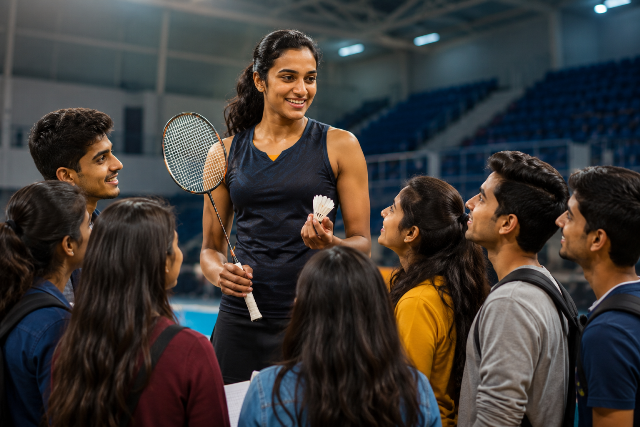
The girl from Hyderabad who changed what India believed was possible
People’s University | Bhopal | July 2026
The numbers first because they earn attention
14 years old when she first played internationally. 17 when she broke into the top 20 in the world. Silver at Rio 2016. Gold at the BWF World Championships in 2019 — the first Indian woman to win it. Bronze at Tokyo 2020. The first Indian woman in history to win two Olympic medals. Only the third Indian athlete ever, alongside Norman Pritchard and Sushil Kumar, to win two individual Olympic medals.
Five medals at the BWF World Championships across her career. Gold at the 2024 Badminton Asia Team Championship — India’s first in that event. In Forbes’ list of highest-paid female athletes for six years running, 2018 to 2024. Padma Shri in 2015. Rajiv Gandhi Khel Ratna in 2016. Padma Bhushan in 2020.
Badminton’s active participation in India went up 65% in four years. 57 million fans now. A significant chunk of that shift has one name behind it.
What her story is actually about
People talk about Sindhu in terms of medals. The medals are real and they are remarkable. But they are not the most interesting part.
She started walking 56 kilometres a month as a young teenager between home and the Pullela Gopichand Academy in Hyderabad. The academy is not gentle. The hours are long and the standards are brutal and there is no shortcut through any of it. She did that for years before she won anything significant.
And then she started losing finals. Rio 2016 — silver. World Championship 2017 — silver. World Championship 2018 — silver. Three big finals, three second places. A lot of people would have quietly adjusted their idea of what they were capable of. She went back and won the 2019 World Championship gold instead.
Then a difficult 2023. Form dropping. Results not coming. She came back in 2024, led India to gold at the Badminton Asia Team Championship and ended the year by winning the Syed Modi International title, finishing a two-year drought. Paris 2024 knocked her out in the round of 16 and she said it was one of the hardest losses of her long career. And then she kept going.
That is the story. Not the trophy shelf. The fact that she kept going when it would have been very easy not to.
Why this matters to a student sitting in Bhopal
Not every student at People’s University is chasing an Olympic medal. Most of them are chasing something else entirely. A medical degree. A law career. A management role. A future in nursing, pharmacy, engineering or media. The specific pursuit is different. The shape of the challenge is not.
Every student hits the stretch where the effort is not matching the result. Where the preparation was serious but the exam did not go the way it should have. Where the goal feels further away than it did when they started. That moment is not a sign that the wrong path was chosen. It is just part of the path. Sindhu’s career is one long example of what it looks like to keep going through that moment instead of adjusting the ambition downward.
The law programme at PILS teaches students to argue when the case looks difficult. The nursing college trains people to stay steady when the stakes are high. The management programmes at PIMR build people who can read a situation that is not going their way and find the line through it. These are not academic skills. They are the same skills Sindhu has been demonstrating on a badminton court for over a decade.
India at Lord’s — the same spirit, a different court
Something happened yesterday that belongs in the same conversation.
The third ODI of the India versus England series was played at Lord’s on July 19, 2026. England won by 27 runs in a series decider that went right to the end. England finished at 387 for 3. India chased hard and finished at 360 for 7.
Rohit Sharma had been carrying questions about his form coming into this series. He answered them with a century at Lord’s — his first at the Home of Cricket. Virat Kohli scored 74, his highest ever at Lord’s in international cricket. India pushed deep into the chase. Sam Curran’s variations and Bethell’s spell proved just enough for England to hold on and take the series.
India lost the match. But a team that believes it can chase 388 at Lord’s against England, that produces a Rohit hundred in a series decider under that kind of pressure, is not a team that built that belief overnight. That kind of confidence in a dressing room gets built the same way Sindhu built hers. Quietly, over years, through the matches that did not go the right way as much as the ones that did.
What People’s University takes from all of this
Sport and education are not separate things. They are the same thing in different clothes. The focus a student builds sitting through a difficult semester is the same focus Sindhu builds in the gym at 6 AM before a tournament. The patience a law student learns reading a case that does not make sense on first reading is the same patience Sindhu showed coming back after losing three consecutive major finals.
People’s University Bhopal runs one of the most complete campuses in Central India — engineering, law, management, health sciences, media, pharmacy all under one roof. What connects every programme is this — they are training people for the long game. Not for the first result. For the career that gets built across years of showing up.
Sindhu knows how that goes. Rohit Sharma knows how that goes. The students at People’s University are in the middle of finding out for themselves.
Admissions 2026 are open at People’s University Bhopal
Sources
- Britannica, P.V. Sindhu Biography, 2025
- Olympics.com, P.V. Sindhu Career Profile
- BWF World Championships Official Records
- Forbes Highest Paid Female Athletes List, 2018 to 2024
- ESPNCricinfo, England vs India 3rd ODI, Lord’s, July 19, 2026