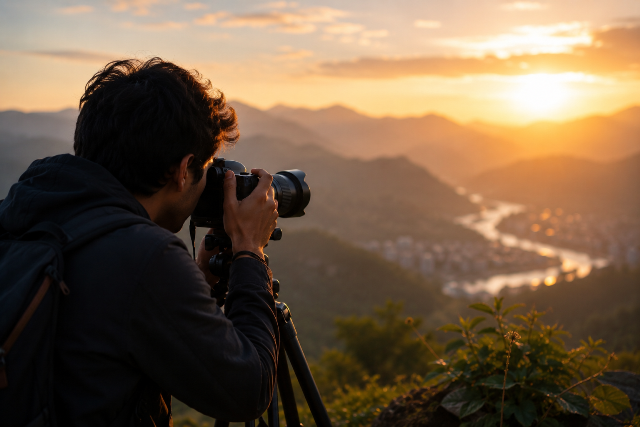
And why People’s University Bhopal’s 84-acre green campus might just be the most photogenic place in Central India to find on
People’s University | Bhopal | August 19, 2026
August 19 marks World Photography Day, going back to 1839 when the French government announced the daguerreotype process and turned photography into something the public could actually use. Fast forward 187 years and there’s a camera in basically everyone’s pocket. More photos get taken in a single day now than existed in the entire pre-smartphone history of the medium. And yet the photo that actually makes someone stop scrolling, the one that shifts how they see something, is still hard to come by. It’s still rare, and it’s still mostly down to the person holding the camera, not the camera itself.
Why photography matters more now than it used to
We’re drowning in images at this point. Billions get uploaded every single day, and feeds move faster than anyone can actually take in what they’re looking at. Most photos get about half a second of attention before someone’s thumb moves on.
In that kind of environment, the photo that actually earns a second look usually isn’t the technically perfect one. It’s the one with something real in it, something specific enough that it couldn’t have come from anyone else standing anywhere else at that exact moment. That’s a skill, not a setting on a phone.
And it’s a skill people are genuinely paying for now. India’s visual content market has been growing at over 20% a year. Brand photography, documentary work, photojournalism, social content, weddings, architecture, wildlife, none of this is side income anymore. There’s real demand behind it and an industry that’s actually building itself around it.
A 2025 FICCI-EY report on India’s media sector listed visual content as one of the five fastest growing segments in the whole industry. Every brand, every OTT platform, every NGO running a campaign needs someone who can make an image people actually stop for. Plenty of people know how to use a camera well these days. Far fewer know how to tell a story with it, and that gap hasn’t really closed.
The campus that photographs itself
There’s a particular quality of light on the People’s University campus early in the morning, the kind that comes through the trees at a low angle and makes ordinary corners of the campus look worth photographing.
The 84 acre campus in Bhopal wasn’t built to be a photography location, obviously. It was built to be a university. But between the green stretches, tree lined paths, open lawns and the mix of architecture across an engineering and health sciences campus, you end up with layered, textured spaces that photographers actually look for, places where there’s something worth including in the foreground, the middle and the background all at once.
Media and journalism students at PIMS use the campus fairly often for their storytelling projects, and it’s easy to see why. The nursing college, the dental academy, the engineering block, the canteen, the open grounds, each one has its own light, its own rhythm of people moving through it, its own texture. A campus this size, with this much greenery and this much everyday human activity, ends up being a genuinely good place to photograph without anyone planning it that way.
Wildlife photographers will tell you the best subjects never pose. A university campus works on the same logic. Real people going about real mornings, nothing staged.
Photography as a career, and what that actually looks like in 2026
Photography in India used to mean weddings and portraits, mostly. That’s changed a lot in the last five years. Now it stretches into brand work, documentary, fine art, photojournalism, medical photography, architectural photography, and the still growing world of content made for social media.
Brands that used to grab a stock image now commission real photography, because people can tell the difference between the two. OTT platforms need photography professionals across entire productions. News organisations covering a country changing as fast as India need photojournalists who can shoot quickly and edit even quicker.
Medical photography doesn’t get talked about much, but it’s one of the steadier growing specialisations, documentation for research, clinical case records, medical illustration. At a university where health sciences, pharmacy, dentistry and nursing sit right alongside engineering and media, there’s an overlap here that most photographers haven’t really clocked as an actual career path yet.
PIMS covers visual storytelling, photojournalism and content production as part of its curriculum, which makes sense given how much print, broadcast, digital and social media have all folded into each other. A media graduate who can’t shoot strong visual content is genuinely missing something the industry expects now.
What this day is actually asking
Every World Photography Day brings the same wave of pretty pictures across social media. Golden hour shots, street portraits, abstract frames. Nice to look at, worth sharing, but that’s really just the surface.
The harder question underneath it is who’s telling the stories that haven’t been told yet. Which places, which communities, which moments in a country changing this fast are going undocumented simply because nobody curious enough with a camera has shown up there.
India right now is one of the richest places on the planet to photograph, 1.4 billion people, changing faster than any generation before could have predicted, holding within it thousands of stories the rest of the world hasn’t seen yet.
The people who’ll end up telling those stories are out there somewhere already, in classrooms, on campuses, slowly figuring out that the way they see the world isn’t quite the way everyone else does. That difference is usually the whole reason anyone’s worth following.
On this campus, on this day
At People’s University Bhopal, World Photography Day is a decent reminder that education doesn’t only happen inside a lecture hall. Some of it happens in the habit of actually looking, asking what’s going on in this room, on this campus, in this city, and then having the skill to show it to someone else in a way that makes them stop too.
PIMS builds that skill formally, and the campus gives students the room to practise it every day. Across health sciences, engineering, law, management, pharmacy and media, there are more stories on this one campus than most photographers would come across spending years looking elsewhere.
Happy World Photography Day. Go find the frame nobody else is looking for.
Admissions 2026-27 are open at People’s University Bhopal.